“Viņš ir Filadelfijā.” He’s in Philadelphia. “Viņa mira.” She died. Snippets of conversation revealed some of what has happened in the half century since a Latvian high school in Augsburg, Germany, closed its doors as Displaced Persons began to move to new homes overseas.
Former students of the Auseklis high school, which from 1946-1950 served students from two Displaced Persons camps, met July 21 during the 11th Latvian Song Festival in Chicago. The gathering was organized by Biruta Abula of Michigan, herself a 1949 graduate of the school. She’s been collecting information about her former classmates for a number of years.
The reunion was one of several gatherings of former DPs held during the song festival. Other groups that met included those from Esslingen and Wuerzburg.
The Latvian students came from the Hochfeld and Haunstetten camps, according to Abula. The high school, or ģimnāzija, came about at the urging of American military officials who were in control of that part of Germany after World War II. About 250 students attended the school, Abula recalled. The high school represented part of a refugee educational system that included elementary schools and institutions such as the Baltic University (Baltijas universitāte).
Abula said she thought only about five people would show up. Instead, more than 25 came to peruse lists of students Abula has tracked down, reminisce over old black-and-white photographs and share stories about their classmates and teachers.
It was clear that for these former students, their high school years are remembered fondly. In one photo album, images showed smiling students posing together for class pictures. A few portrayed athletic and cultural activities, such as dancing. Reunion participants pointed out each other, telling tales as they went. Some reassembled to have new class pictures taken.
If time allowed and the participants were willing, the reunion would have been a wonderful opportunity for Abula to record what these former high school students remembered about their time in Augsburg. Abula admitted it’s hard to convince people to make the effort.
But the effort has to be made. Too much of Latvian history, both in Latvia and abroad, has been lost. In the case of the Displaced Persons camps, some work has been done to retrieve that history, but much remains. Rediscovering stories such as those of the Auseklis high school would serve not just to rekindle the memories of former students, but would help all of us understand the formative years of a generation that for many years led exile cultural, social and political life in the United States, Canada and elsewhere.
And with hundreds of thousands of displaced persons still wandering the globe, thanks to any number of conflicts that have upset many homelands, improved knowledge about the Latvian DP experience might help others to deal with their particular need for ethnic survival.
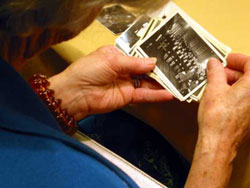
A reunion visitor looks through a handful of old photographs of the Auseklis camp high school. (Photo by Andris Straumanis)
Andris Straumanis is a special correspondent for and a co-founder of Latvians Online. From 2000–2012 he was editor of the website.


