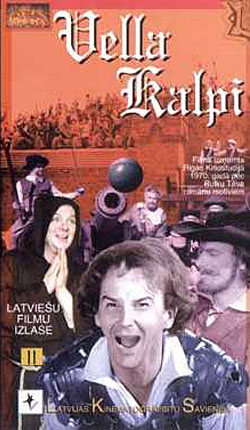
A swashbuckler with Latvian role models

Vella kalpi

Vella kalpi is my first memory of a Latvian film. I recently saw it again. Unfortunately, it has not aged well. The cinematography is average at best, the sound is tinny, the story overblown and the acting hammy. About the only part of it that doesn’t seem to have aged is Raimonds Pauls soundtrack. Then again, if you aren’t a big fan of Pauls that isn’t much to crow about either. Despite all of that, I still loved it and always will.

You have to understand this film in its context. You have to see it through the eyes of an 8-year-old, sitting in a darkened theater, eyes glued to the screen. An 8-year-old who was growing up in a confusing world not of his own making. Trying to make sense of a contradictory existence that adults only whispered about. I was a Latvian and I lived in Latvia, but I lived in Soviet Latvia. Up to this point my mythology only contained Soviet heroes. They might have spoken Latvian. They might have been Latvian, but at the core they were Soviets. This was the first time I had ever seen Latvian heroes and I couldn’t tear my eyes from the screen.

Basically, Vella kalpi is a swashbuckler. The film itself is based on the stories of Rutku Tēvs, but anyone familiar with the many variants of the “Three Musketeers” will recognize the plot. It’s about three young men who, motivated by both circumstance and national pride, rise up to protect Rīga from a foreign invasion. They do this with strength and cunning, exhibiting all of the traits that we consider to be Latvian: hard work, loyalty and a sense of humor.

I am sure that the film was supposed to reinforce the Soviet ideals of being vigilant to bourgeoisie ideals—our heroes are strapping farm lads with simple tastes and simple needs, and all of the villians were either nobility or foreigners—but all I could see was Latvian heroes doing great deeds with a great bit of panache.  This is who I wanted to be when I grew up.

It was my first exposure to Latvian role models outside of my own family. You might think it hyperbole, but you have to understand the total control that the Soviets had over all media. The goal of Soviet media was to produce good Soviets and not good Latvians. Perhaps the most amazing thing is that this movie managed to bypass all of that. While on the surface seems to reinforce Soviet mythology, at its heart it is about Latvian identity and Latvian ideals.

Details

Vella kalpi

Aleksandrs Leimanis, director

Rīgas kinostudija,  1970

Notes: In Latvian. Musical/adventure/comedy, color, 80 minutes. Principal actors: Olga Dreģe, Arturs Ēķis, Eduards Pāvuls, Elza Radziņa, Haralds Ritenbergs and Kārlis Sebris; screenplay: Jānis Anerauds (based on the stories of Rutku Tēvs); music: Raimonds Pauls.
‘Likteņdzirnas’ contrasts ideals, realities

Likteņdzirnas

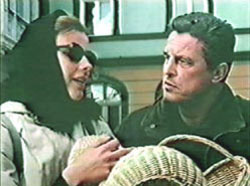
Eduks (Ivars Kalniņš) is reunited with his student, Agnese (Agnese Zeltiņa), in the streets of Old Rīga.

Likteņdzirnas is a flawed film that manages to capture the spirit of the years shortly following Latvian independence—despite its tendency towards overwrought sentimentality and substandard production values.

Eduks (Ivars Kalniņš) is a college professor caught between the reality of the present and the desire to regain the past. He has inherited a mill. To him the mill holds priceless sentimental value. To his ex-wife and children the mill has only monetary value. He wants to restore the mill to its former glory and live happily ever after in its pastoral setting. Everyone else is pressuring him to sell it and get all that he can while he can. There is no shortage of buyers, including Vincent (Romualds Ancāns), a quasi-Mafiosi who wants to turn the mill into a Roman bath and brothel. Eduks is joined in his struggle to restore the old mill by Agnese (Agnese Zeltiņa) and Beisiks (Artūrs Skrastiņš). Agnese is an old student of his who, in a twist of fate, had lost her eyesight. Beisiks is a young musician wandering from job to job who knows every Latvian folk song, but dresses like a Metallica groupie.

This broad soap opera outline is symbolic of all that was happening in Latvia at the time and, to a point, is continuing in the present day. Shortly after independence, as people reclaimed properties usurped by the Soviets, similar real-life stories were played out all over Latvia. The joy of our regained independence often had to take a back seat to the need to live and the desire to thrive in a capitalist society. This was a society in which traditional Latvian values at times clashed head on with the realties of having to make a buck.

Eduks represents the idealized model of what a Latvian is: strong, stoic and with a lyrical love of the land. He is always willing to do the right thing. Vincent symbolizes the forces of change that were sweeping through the nation. He borders the fine line between a legitimate businessman and an old fashioned crime boss. Beisiks symbolizes the lost youth of the current generation: aimless and fatalistic, proud of his heritage while adopting the mannerisms and language of Western culture, trying to bridge the two into one. Agnese represents the Latvians who have decided to make the best of what they have despite all of the obstacles.

Likteņdzirnas is not a great film, but it is a good one. Director Jānis Streičs starts off slowly, but eventually manages to create a believable story full of lyricism and warmth. However, what really makes the film work is the performances of the actors, primarily of Skrastiņš. Skrastiņš manages to capture the dichotomy of Latvian youth, caught in a mess that was not of their making and persevering with a combination of fatalistic resignation and youthful exuberance and optimism. Kalniņš brings just the right note of soul to Eduks without, as often happens in Latvian films, making him seem overly dramatic and brooding.

This film could have easily have turned into a heavy melodrama, but in the end it manages to tell its story with humor and warmth. It captures the hardships of adjusting to a new world and manages to show the difficulty of reconciling our expectations with the realities of life. There is a bit of these characters in all of us.

(Editor’s note: This review originally appeared on author Andrejs Makwitz’s Web site, The Latvian Film Page, and is republished with permission.)

Details

Likteņdzirnas

Jānis Štreics

National Film Center of Latvia,  1997

Notes: In Latvian. Drama, color, 105 minutes. Screenplay: Jānis Streičs; director of photography: Harijs Kukels; producer: Uldis Šteins; music: Raimonds Pauls; set design: Ieva Romānova; editor: Maija Indersone; sound: Viktors Ličovs; principal cast: Ivars Kalniņš, Agnese Zeltiņa, Artūrs Skrastiņš and Romualds Ancāns.

‘Kurpe’ studies absurdity of Soviet Latvian life

Kurpe

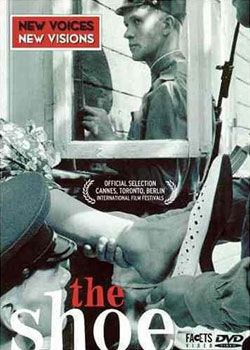
Three young soldiers discover a woman’s shoe on a sandy beach and chaos breaks out. Sirens go off, officers appear and hurried orders are shouted out. Welcome to Liepaja, Latvia, 1950. The new frontier. A time of paranoid suspicion, absurd reality and good old fashioned Latvian stoicism.

The story of Laila Pakalniņa’s Kurpe (The Shoe) reflects the absurdities of Latvian life in the early days of the Soviet occupation. This was the period in which the sand of Liepāja’s coastline was dredged each night by a tractor, like a conscientious golfer would a sand trap, and the following morning checked for fresh footprints.

When a pair of border guards discovers a woman’s shoe in the sand that wasn’t there the previous night, it could only mean one thing: a saboteur must have landed. It is the only possible explanation.

The commander of the border guards orders them, in classic Soviet fashion, to find the woman to whom the shoe belongs in the most direct manner possible. They are to traverse the city and to see whom the shoe will fit. A bit of Soviet Cochranism: “If the shoe will fit, you must convict.”

What ensues is an absurd tale that reflects the absurdities of Soviet life. Pakalniņa’s direction and cinematography perfectly complements the realities of the time. The film is an “art” film and as such might not appeal to those who are used to more traditional forms. There is very little dialogue and the plot assumes that the viewer understands the backstory. The shot selections often will often have the characters shot in silouethes or as reflections. The cinematography is in high contrast black and white.

However, for what it tries to be it is a nearly perfect film. The pacing and the style perfectly capture the helplessness and pragmatism of Soviet Latvian life. The ability of people to persevere with stoic resignation, all the while never quite submitting to their fate.

Pakalniņa’s background is in experimental and documentary films and it shows in the best possible way in this film. Kurpe resists the temptation to judge the period, but presents it in a straightforward manner allowing the audience to reach their own conclusions. Often films like this tend to be a bit heavy, but Kurpe never crosses the line.

Pakalniņa is greatly helped by the actors’ ability to appear natural. Their understated performances make the film’s absurd tone even more poignant.

In many ways this film shows how to accomplish a lot with a little. According to Pakalniņa, the story and the style were driven by the fact that she could not find the funding for some other projects and in the meantime decided to film a story with what she had available.

(Editor’s note: This review originally appeared on author Andrejs Makwitz’s Web site, The Latvian Film Page, and is republished with permission.)

Details

Kurpe

Laila Pakalniņa

Schlemmer Film GmbH,  1998

Notes: In Latvian and Russian. Drama, black and white, 83 minutes. Screenplay: Laila Pakalniņa; director of photography: Gints Bērziņš; editor: Sandra Alksne; producer: Christoph Meyer-Wiel; principal cast: Igors Buraks, Vadims Grossmans and Jaan Tatte.