Two films about real people in extraordinary times

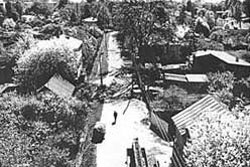
A bird’s-eye view of Crossroad Street opens the original documentary, Šķērsiela.

The best fiction films are the ones that manage to capture some element of real life. It doesn’t matter if they are set in a galaxy far, far away or taken straight from today’s headlines. They feel real no matter how contrived.

The best documentary films work in reverse. They take real life and give it scale and resonance that makes one forget that what we are watching is the mundane and common. They take things and events in life that most of us don’t pay too much attention to or take for granted and elevate them to epic status.

Ivars Seleckis’ documentaries Šķērsiela (Crossroad Street) and Jaunie laiki Šķērsielā (New Times at Crossroad Street) accomplish this with such effortless ease that one forgets that these are documentaries. They feel real and surreal at the same time. Both films take place in a small street in the Pārdaugava section of Rīga. The first was filmed in 1988 and the second a decade later in 1999.

The first film slowly introduces us to the residents of Crossroad Street.

There’s Julis the cab driver and his arch-enemy and neighbor, Aldis, a stone mason and part-time preacher, who has set up a what seems to be a major monument-making factory in his backyard. It’s a noisy undertaking and a constant source of irritation to straight-laced Julis.

There’s poor Daiga, pregnant and abandoned by her lover. She lives as an unregistered guest of her cousin in the same house as Julis, his wife and his daughter. She fears that any moment she will be kicked out into the street. The house itself was built by and belonged to her grandfather, a famous Latvian writer, during Latvia’s independence. It has been turned into communal housing by the Soviets. Daiga is now nothing more than a squatter.

There’s Osis, feeble-minded but gentle, who lives with his 80-year-old mother. There’s Tolik, the son of a Latvian mother who was deported to Siberia and a German father whom she met and fell in love with there. He speaks only Russian and can barely move because of an untreated childhood disease he contracted in Siberia. There’s Pēteris and Olga, a bickering but loving, easy-going old couple who grind horseradish in their backyard for sale in the market. There’s even a glimpse of the mysterious Casino Plūmiņš tooling around in his žigulis.

There are many more, but they all present a cross-section of Latvia and, as the title suggests, find themselves at the crossroads as a dying empire takes its last gasps. Their lives are filled with chaos and pathos. Aldis, the stone mason preacher, keeps mouthing homilies about the spiritual life while in constant pursuit of earthly rewards. Julis finds himself lost in this new chaotic world, not nostalgic for the past, but resentful at having to live in a world in which a taxi driver no longer has the same status as his enterprising stonemason neighbor. Then there is poor Daiga who, despite it all, keeps smiling through the tears.

Jaunie laiki Šķērsielā revisits the neighborhood 10 years later. Nothing is the same and at the same time it all seems strangely familiar.

Daiga, the helpless young woman, is now a mother with a 10-year-old son. The house from which she was kicked out is now entirely hers and she is busy making it into her little safe haven. She has a job and a man and a healthy and happy son. She is strong and vibrant and in full control of her life.

Aldis is still as devout as ever, if not more so, but his business has fallen on hard times. Racketeers have burned down his modern workshop and he now has to fight for control over his property with Gaļina, his father’s second wife. Daiga has just turned off his water, water which he has been poaching off her pipes for his workshop all of those years.

Pēteris and Olga are still making horseradish in the back yard and bickering in loving fashion. And Casino Plūmiņš is now tooling around in a brand new Mercedes and living in a house right out of the pages of Architecture Digest with his beautiful artist wife.

A lot of old shacks on Crossroad Street are being torn down or remodeled and rebuilt. There is also a huge new addition to Crossroad Street: a mansion built by a mysterious and wealthy Gypsy. Side by side we see modest, well-kept family homes with tidy gardens and run-down buildings with junk-filled yards. Times have changed mostly for the better, but in some ways for the worse. Latvia is independent and people have freedom to take control of their lives. But there is still chaos and uncertainty. People are rebuilding, but the first thing everyone seems to put around their property is a sturdy fence.

An abandoned freight train rests on the nearby railroad tracks. Everyone has to duck and walk under it if they want to get to the store. Osis now receives his disability pension in lats and not rubles, but it is still barely enough to get by and perhaps even less than it was before. Tolik’s health has taken a turn for the worse. And Casino Plūmiņš, despite all of his wealth, seems sad and lost and hungry for something that he just can’t reach.

The magic of Šķērsiela and Jaunie laiki Šķērsielā is that they allow us an entry into these peoples’ lives. It’s an honest look that neither glamorizes nor minimizes real life—real life as lived by real people in extraordinary times.

Details

Šķērsiela & Jaunie laiki Šķērsielā

Ivars Seleckis, director

European Documentary Film Symposiums,  1988 and 1999

Notes: Šķērsiela: Documentary, black-and-white, 85 minutes. In Latvian. Script: Tālivaldis Margēvičs; camera: Ivars Seleckis; music: Ivars Vīgners. Jaunie laiki Šķērsielā: Documentary, color, 85 minutes. In Latvian. Script: Tālivaldis Margēvičs; director of photography: Ivars Seleckis; editing director: Maija Selecka; music: Ivars Vīgners; producer: Leonīds Bērziņš.
CD-ROM reminds us of Podnieks’ greatness

Juris Podnieks was one of Latvia’s best-known and most successful filmmakers. His accidental death in 1992 was a tremendous loss to Latvian film. Podnieks’ unique combination of talent, determination, skill, courage and incredible ability to motivate others to exceed their limits allowed him to create films that transcended their subject matter. His films are comparable to similar works by such notable documentary filmmakers as Errol Morris and Ken Burns.

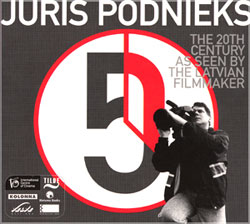
In celebration of what would have been his 50th birthday the Latvian film forum Arsenāls put together a CD-ROM in his honor titled Juris Podnieks: The 20th Century As Seen by the Latvian Filmmaker. It is a must-have for all those with an interest in Latvian film and Latvian and Soviet history.

Podnieks and his crew were on the front lines as Latvia and many others nations emerged from the yoke of Soviet occupation. His films captured the tenor of the times and the courage and determination of a people who would not be denied. Is It Easy to be Young? played to packed movie houses all across the Soviet Union and won numerous international awards. It captured the alienation of youth and the banalities of the Soviet Union at a time when to even raise the specter of such issues still carried a great deal of risk. Homeland captured the unraveling of the Soviet Union in vivid detail while chronicling the "singing revolution" in the resurgent Baltic republics. Homeland. Postscript chronicled the nightmarish crackdown by Soviet authorities. Two of his closest friends and collaborators, cameramen Gvīdo Zvaigzne and Andris Slapiņš, were killed in Rīga during filming by OMON troops.

The CD-ROM is full of details about Podnieks the filmmaker and the person, as well as general Latvian history. However, the true standouts are the bits and pieces from Podnieks’ various films. It is impossible to watch them without being affected, both by their strength of vision, and powerful message, and by feeling a profound sense of loss at the death of the man who made them. His death at the age of 42, an age when filmmakers enter their best and most productive years, is still being felt across the Latvian film industry.

You can’t help but be affected by footage of a young man, in Is It Easy to be Young? breaking down in a court room, while a passive monotone voice reads the judgment of the court that sentences him to three years in prison for getting carried away during a rock concert. In We, a series of documentaries on the Soviet Union made by Podnieks for England’s Channel 4, the audience gets a glimpse of the incredible courage that it took to stand up to the Soviets.

In what was either an intentional or unintentional homage to the Odessa steps sequence in Sergei Eisenstein’s The Battleship Potemkin and is eerily similar to a similar event that took place in Tianamen Square years later, a woman runs into the frame and tries to stop armed soldiers from getting down an outdoor staircase to break up a protest in Armenia. In Homeland. PostScript you watch with horror the footage of both Zvaigzne and Slapiņš getting shot as Slapiņš, despite being mortally wounded, exclaims, "Keep filming!"

The only flaws of the CD-ROM are that the text, most likely written by a non-native English speaker, seems stilted and ackward at spots, and that there isn’t more footage of Podnieks’ works. It’s ironic in a way. Podnieks was known for almost never using narration in his films. He allowed the subjects to speak for themselves. It’s a shame that we couldn’t have more of his films on this CD-ROM, and in the future, to do his speaking for him.

Details

Juris Podnieks: The 20th Century As Seen by the Latvian Filmmaker

Augusts Sukuts et al.

Rīga:  International Centre for Cinema Arsenāls,  2000

Notes: Minimum requirements are a Windows 95 Pentium-based computer computer at 166 MHz, 32 MB of RAM, 2X CD-ROM, 256-color monitor with 800×600 resolution, sound card, QuickTime 3.0.

The good, the bad and the satirical

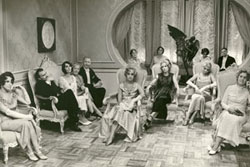
Pre-World War II Latvian industrial leaders, politicians and bankers—and the lives they lead—are studied in Ceplis.

It is impossible to view Ceplis, directed by Rolands Kalniņš and starring Eduards Pāvuls, without putting it in the context of the time and place it was made. The year was 1972 and the place was Soviet Latvia. There is good and bad here.

The good part is that this is a great-looking film. The cinematography jumps right off the screen. Looking at the film with the sound off you could imagine that this was a film from Hollywood or Western Europe, circa 1970. The lighting is just right, the composition of shots shows attention to detail, the costumes and actors are all just so. One of the advantages of working in the Soviet system was that filmmakers had access to equipment, although it was usually quite a few notches below what was available in the West. But they had crews and talent to milk that equipment. They also had time to film without the usual budget constraints that present day productions have to deal with.

Unfortunately, watching a film with the sound off stopped being a true option since The Jazz Singer premiered in 1927. It’s not that the acting in Ceplis is bad or that the technical quality of the sound is that bad. (The movie seems to have been shot without sync sound and the dialogue added at post-production, but I am discovering that is more of a pet peeve of mine that doesn’t bother most. Fellini shot most of his films this way and few complain about his work.)

The bad part is that because the film was made in Soviet Latvia in 1972, it couldn’t just focus on telling a story without also, none too subtly, having to impart some ideological message. It is this need to drive home an ideological message that ultimately sinks the film.

Ceplis is the story of the ultimate survivor. It tells the adventures, or misadventures, of a 1930s businessman who will do anything to survive and prosper. Ceplis (Pāvuls) establishes a joint stock company that will make bricks from Latvian clay (brūnais zelts, or brown gold) and sell them overseas. There is no shortage of those who are lured by the promise that the phrase "Made in Latvia" will soon ring across the world. The possibility of becoming rich beyond their wildest dreams doesn’t hurt either. Soon everyone is scheming to acquire as much stock as they can. Alas, the clay used for the bricks contains too much chalk, the bricks themselves are worthless, and as fast as they tried to get in on the deal everyone soon wants out.

This is not a subtle film. Not a single character is motivated by anything other than greed. All of them—from the mighty captain of industry to the lowliest office clerk, from the highest politician to the local police officer, and even their wives and paramours—are tainted by either their proximity to, or desire for, wealth. And it is this greed, of course, that leads to their eventual downfall.

The film’s screenplay is based on a novel, written by Pāvils Rozītis in the 1930s, that was intended as a satire of contemporary times. But the film comes across as a heavy-handed attempt at illustrating the evils of capitalism and, by extension, Latvian nationalism. Greed is bad. Nationalism is merely a tool to justify greed.

Ironically, this same stereotypical presentation of Latvian business people and politicians can be found in the present. Let’s hope that if anyone ever thinks of remaking Ceplis they will remember that satire works best when it is subtle.

Details

Ceplis

Rolands Kalniņš, director

Rīgas Kinostudija,  1972

Notes: In Latvian. Drama, monochrome, 72 minutes. Screenplay by Viktors Lorencs, based on a novel by Pāvils Rozītis; camera: Gvido Skulte; music: M. Zariņš; principal cast: Gunārs Cilinskis, Helga Dancberga, Eduards Pāvuls, Regīna Razuma, Aivars Siliņš, Velta Straume and Rolands Zagorskis.