Soviet-era film is now a Jāņi tradition

Limuzīns Jāņu nakts krāsā (Limousine the Color of Midsummer Night) is perhaps the favorite film of Latvians. Like the American Christmas tradition of watching It’s a Wonderful Life, it has become a staple on Latvia’s television screens around Jāņi, the Latvian celebration of the summer solstice. Written by Māra Svīre, it is director Jānis Streičs’ best film.

It is a film that can be watched on many levels. At the surface it is a broad comedy with universally recognizable characters and themes that are also uniquely Latvian.

Aunt Mirta (Lilita Bērziņa) wins a car in a lottery and faster than you can say “priekā,” relatives and acquaintances descend on poor Mirta’s house like locust. There’s her nephew (Uldis Dumpis) who, with wife and son in tow, gets off a tour bus in mid-excursion and hitchhikes to Mirta’s house for a visit the moment he hears of her windfall. There’s her former daughter-in-law, with husband and daughter along, who pop in for a visit out of the blue. Even her next door neighbors, hard working and earnest farmers, are suddenly more helpful and attentive. None of this is lost on Mirta and she makes the most of it.

It’s a very Latvian film. There’s a Latvian folk tale about a poor traveler who stops by a farmstead. Being hungry he asks the farmer’s wife for some food and she promises him a meal in exchange for work. The labor is backbreaking, but he does it without complaint. When he finishes, the stingy farmer’s wife tries to renegotiate. Pleading poverty, she offers him some thin soup. He doesn’t complain, but as he sips the watery brew he remarks that the soup is missing something. It needs something to go with the broth. The farmer’s wife apologizes and says she has nothing else to offer. All she has left is an old axe.

The axe will be good, he replies. The farmer’s wife is incredulous, but he reassures her that in his travels he has often had axe soup and its one of the best meals he has ever had. You just have to know how to prepare it properly and it will be as tender and savory as the finest cut of meat. The farmer’s wife, seeing an opportunity to make something out of nothing, drops the axe in the pot. But no matter how long they wait, the axe stays, well, as hard as an axe.

The traveler recalls that the last time he had axe soup it also had some potatoes in it. Maybe that’s what’s wrong? The potatoes tenderized the axe. Suddenly the farmer’s wife remembers that she might have some potatoes. Into the pot they go. The axe still is hard. Maybe it was the carrots? There’s carrots. Cabbage? Here’s cabbage. On and on and into the pot they all go. Of course the axe never becomes any softer, but in the meantime the traveler has himself quite the meal.

Limuzīns Jāņu nakts krāsā is like that folk tale in reverse. It’s the poor old farmer Mirta who exploits the greed of her guests. It doesn’t take long before they are cutting her grass, building her a new cellar and doing all of her cooking and cleaning—all on the chance they’ll be ones to end up with the car.

The film also can be viewed as one of those typical Soviet morality plays about bourgeois values being a corrupter of the human spirit.

However, most importantly, it’s a film that, between the lines, managed to pillory and parody the Soviet system. Where else but in the Soviet Union would an 80-year-old woman who can’t drive end up with a car that she has no use for and doesn’t really want, while everyone else has to scrape and then wait for years to end up with one? Even the title itself is a sarcastic reference to a car that was the Soviet equivalent of a Ford Pinto in a color that can be best described as off-white.

Limuzīns Jāņu nakts krāsā works on all of those levels. Like most of Streičs’ films, it’s about characters and relationships. The film is filled with humor and warmth and great performances. But it is the film’s ability to amuse—while parodying a system that didn’t tolerate being parodied—that is perhaps its greatest achievement.

Details

Limuzīns Jāņu nakts krāsā

Jānis Štreics

Rīgas kinostudija,  1981

Notes: In Latvian. Comedy, color, 79 minutes. Screenplay: Māra Svīre; director of photography: Harijs Kukels; music: Raimonds Pauls; principal cast: Gundars Āboliņš, Romualds Ancāns, Lilita Bērziņa, Olga Dreģe, Uldis Dumpis, Baiba Indriksone, Līga Liepiņa, Boļeslavs Ružs, Ēvalds Valters and Diāna Zande.
In 1995 film, the worst of both worlds

Drosme nogalināt

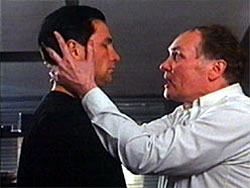
Ēriks (Armands Reinfelds) listens to his father (Uldis Norenbergs) plead for his life.

No one ever sets out to make a bad film, but somehow they get made anyway. Drosme nogalināt (The Courage to Kill), released in 1995, is a bad film and in so many different ways that it’s not easy to pinpoint where it went wrong or why it was made in the first place.

It could be the script. It isn’t often that you run across an Oedipus complex story set in a strip club. Our oedipal hero, Ēriks (Armands Reinfelds), seems to earn a living by cross-dressing (as, surprise, Ērika) so that he can tag along with the girls when a patron decides to take one of them home. He then ransacks the house while the john has his way with the girl. The only time we see him actually attempt this he gets beaten to a bloody pulp.

I say “seems” because he doesn’t seem to do much other than hang out in the strip club. I’d imagine that couldn’t be cheap. You would think that the owners of the club would eventually wise up. It can’t be good for business. Nor is it clear why exactly someone who has just scored two beautiful women would only pay attention to one of them while the other has free run of his house. I’ve never read Oedipus Rex or seen the play. I understand that it isn’t very subtle either, but I don’t think this is quite what Sophocles had in mind. But Ērika does look stunning in her high heels.

The script has many other flaws. You can’t have an Oedipus without a father, but other than the predictable flashback scene where Ēriks watches his father having sex with the maid, with whom young Ēriks is in love, we’re not sure what motivates either character. The father (Uldis Norenbergs) just shows up and moves into Ēriks’ apartment one day, much to Ēriks’ dismay. Where he was before, why he chose to show up just then, and why Ēriks doesn’t just kick him out or just simply change the locks isn’t made clear. Well, it’s clear enough, but not particularly imaginative: Oedipus needs a father. Otherwise, it wouldn’t be much of a complex.

It could be the acting. As you can tell by the title and story, this isn’t a very subtle film. Neither are the performances. This is the kind of film where characters laugh too loud. Their feelings are spelled out on the screen in capital letters. There is no middle ground.

It could be the direction (the film was Aigars Grauba’s and Igors Linga’s debut). The film was based on a play by the Swedish playwright Lars Noren. I would assume that the play wasn’t nearly as bad, otherwise, why remake it as a film? Unfortunately, things that work in an intimate theater setting don’t always work on film. You have to ratchet them down just a bit. For example, Ēriks is walking down a hallway and bumps into a stripper. They obviously have a past. She grabs him by the crotch and suggests he stop by later. Get it?

The name of the production company that made Drosme nogalināt is Between Europe and Hong Kong Productions. I hope this was some sort of allusion to the film genres of Europe and Hong Kong. It would be the most creative touch of this film.

Europe is famous for making films of artistry and depth. They are not afraid to tackle taboo subjects and present them in a way that does not pander to the lowest common denominator—when they work. When they don’t they seem pretentious and boring, as exciting as witnessing a third-rate poet’s therapy session in a badly lit room. Hong Kong is known for exciting action films that hide what they lack in nuance and story by keeping the action coming at such a furious pace and with such visual panache that you don’t have much time to dwell on it—when they work. When they don’t there is no amount of atmospheric lighting and fast paced editing that can make you not regret picking movies because of the cool cover art and the blurbs on the back of the video box.

Europe and Hong Kong can be a wonderful combination when it works. In Drosme nogalināt it doesn’t. Instead, we are left with the worst of both worlds.

Details

Drosme nogalināt

Aigars Grauba and Igors Linga

Between Europe and Hong Kong Productions,  1995

Notes: In Latvian. Drama, color, 78 minutes. Screenplay: Hānss Bertilsons, Aigars Grauba and Igors Linga, based on a play by Lars Noren; music: Uģis Prauliņš; costumes: Bruno Birmanis; film editor: Sandra Alksne; principal cast: Maija Jevhuta, Uldis Norenbergs, Armands Reinfelds.

‘Labās rokas’ reveals itself as a good choice

Labās rokas

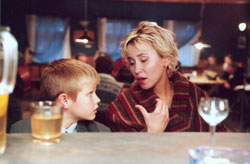
Small-time Latvian thief Margita (Rēzija Kalniņa) and young Pavo (Atis Tenbergs) first meet in a small-town Estonian pub. (Photo from Allfilm)

Labās Rokas (Good Hands), the Estonian and Latvian co-production directed by Peeter Simm, is filled with characters and character, sadness and humor. There’s Margita (Rēzija Kalniņa), a two-bit thief who along with her sister will steal anything that isn’t nailed down. There’s Adolf (Lembit Ulfsak), an engineer in a dying industrial town that no longer needs his skills, and his best friend, Dr. Lepik (Tonu Kark), who performs dental surgery on himself with the help of a mirror but without the benefit of anesthetic. There’s Arnold (Tiit Sukk), Adolf’s son, the town’s policeman whose primary job seems to be to ticket his father each time he catches him speeding. And then there’s Pavo (Atis Tenbergs), a caustic and jaded 8-year-old who seems to be going on 80.

All of their lives become entwined when Margita, after stealing a car with her sister in Jūrmala, gets into an accident and has to flee across the border into Estonia. She reaches the outskirts of the town of Vineeri (Plywood), named after a now non-functioning and shuttered plywood factory, and attempts to steal Adolf’s car while he is taking a swim in a river. As she is trying to get away she notices that Adolf still hasn’t come up for air. Thinking that he is drowning she jumps out of the car and tries to save his life, much to Adolf’s disappointment and surprise. Eventually they end up back in Adolf’s house. When Margita finds out about Arnold the cop, who shares his father’s house, she realizes that hiding in the house of a policeman might be the best way to wait for the heat to blow over.

What ensues is an exploration of character and relationships. Simm weaves a simple story that is brought to life by wonderful performances from his cast. Rēzija Kalniņa is almost perfect as a seemingly amoral thief with no loyalty to anyone or anything, but who once literally walked on glass to prove her love. Lembit Ulfsak and Tonu Kark are perfect as a the quarrelsome and quirky odd couple who have long ago learned to accept each other despite their differences. Tiit Sukk, like Kalniņa, is good as the lonely and morose cop, but at times seems a bit too wooden in his performance.

The true standout of the cast, however, is young Atis Tenbergs. When his real mother (Maija Apīne) is admitted to the hospital, he adopts Margita as his surrogate mother and mentor. Its not a novel cinematic device, but Tenbergs pulls it off perfectly as a child in a world of mixed-up and often childish adults who has to be both a child an and adult.

Labās rokas is also an interesting exploration of the two different national characters of Estonians and Latvians and how they perceive each other. Too often the Baltics are seen as a single entity where the people are indistinguishable from each other outside of their languages and borders. The rest of the world might perceive them as “the Baltics,” but they can be as different from each other as night and day. As Pavo’s mother explains to Margita, she loves the town of Vineeri and its people but she is desperate for a conversation with a fellow Latvian. The locals never seem to go beyond “tere” (hello) and xx (goodbye).  On the other hand, the locals perceive the Latvians as “chatty” and “aggressive” and while in public seem remote and cold, on an individual level speak to each other about topics and in an intimacy that most of us are incapable of.

At the heart of it Labās rokas is about individual choices—and living with those choices—as well as loyalty. It is a wonderfully quirky film about wonderfully quirky people who have learned to accept and live with each other. The film has won a few awards on the European film circuit and the Latvian “Lielais Kristaps” for best film. It deserves a broader audience.

Details

Labās rokas

Peeter Simm

Allfilm,  2001

Notes: In Latvian, Estonian and Russian (with English subtitles). Drama and comedy, color, 90 minutes. Screenplay: Toomas Raudam and Peeter Simm; director of photography: Uldis Jancis; producers: Artur Talvik and Gatis Upmalis; art director: Ronald Kolman; sound: Ivo Felt; costumes: Ieva Kundziņa; principal cast: Maija Apīne, Rēzija Kalniņa, Tonu Kark, Leonarda Kļaviņa, Tiit Suuk, Atis Tenbergs and Lembit Ulfsak