
‘Sprīdītis’ raises but doesn’t answer key question

Sprīdītis Amerikā

The documentary film is just part of the “Sprīdītis Amerikā” project. An exhibit of photographs, including this image, has accompanied screenings.

Sprīdītis Amerikā vai Does it Look Like Happiness? tries to answer an important question: Why have so many Latvians in recent years decided to leave Latvia to seek their happiness in the United States, and have they found it?

It’s a much-debated question both in Latvia and wherever else more than two Latvians can be found. Sprīdītis (as well as another film on the same topic, Atrasts Amerikā) has certainly stimulated the debate. But, other than showing that, in general, happiness is hard to find and even harder to define, the film doesn’t really answer its own question.

The fault is perhaps with the premise itself. Looking at Latvia or the United States through the eyes of those who decided to choose one over the other doesn’t really address the merits or faults of either. By definition those who left Latvia found Latvia lacking and chose the United States as a place where whatever it is that Latvia lacks can be found. Those kinds of judgments are best left to those with an objective eye with nothing at stake.

Sprīdītis really isn’t a film about Latvia or the United States, so much as a film about individuals who seek the pot of gold at the end of the rainbow, and they can be found in any immigrant community regardless of county of origin or ultimate destination.

The short answer to whether they found their happiness in America is, well, really neither short nor simple. The film certainly demonstrates that for the most part they have not. But whether this was due to something intrinsic to the respective nations or the individuals in question remains unanswered. One gets the sense that they could have been just as happy or just as unhappy in either place. Their reasons might change, but the degree of either remains the same.

Sprīdītis is not a bad film. Other than at times comical English translation, it is technically well executed. One gets the sense of place and lives. The film flows with a natural rhythm that captures the spirit of the moment it sets out to capture. It fleshes out its background much better than Atrasts Amerikā. Where Atrasts Amerikā was mostly talking heads broken up by cutaways, which didn’t always add to what the heads had to say, Sprīdītis adds background footage that accentuates the interviews.

Overall, Sprīdītis offers a glimpse into the motives and introduces us to people who most of us might never otherwise meet. It’s a film that captures the immigrant experience, the hardships and sacrifices, even if it doesn’t really tell us anything particularly new about the place those immigrants left or the place where they now live.

Details

Sprīdītis Amerikā vai Does it Look Like Happiness?

Ieva Salmane, director

Projekts “Sprīdītis pasaulē”,  2003

Notes: In Latvian and English. Documentary, color and black and white, 52 minutes. Screenplay: Ieva Salmane; director of photography: Māris Ločmelis; composer: Pēteris Helms; production editor: Sandra Alksne; sound editor: Anrijs Krenbergs; video engineer: Andris Zemītis; producers: Ieva Salmane and Māris Ločmelis.

Director’s feature debut is lyrical, mystical

Pa ceļam aizejot

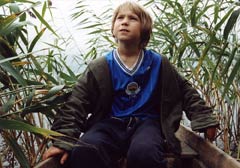
Dāvis Bergs portrays Dauka in the Viesturs Kairišs feature film, Pa ceļam aizejot.

Pa ceļam aizejot (Leaving by the Way) is a lyrical and mystical film that is hampered at times by uneven performances, but bolstered by excellent direction from Viesturs Kairišs.

The winner of the 2002 Lielais Kristaps (Latvia’s equivalent of the Oscar), and based on the classic Latvian story Dullais Dauka (Crazy Dauka) by Sudraba Edžus, Pa ceļam aizejot transports the viewer into a world filled with beauty and heartbreaking tragedy. It transforms a fanciful fairy tale filled with symbolism to the present without losing a single beat or softening its mystical approach. The setting and characters might be “modern,” but the forces that drive them are as old as love and jealousy, curiosity and faith.

Set in a Latgalian village, Pa ceļam aizejot follows the lives of the villages inhabitants in the wake of a tragic event: the loss at sea and presumed drowning of Ivars (Andris Keišs), husband of Ilga (Elita Kļaviņa) and father of Dauka (Dāvis Bergs) and Līga (Līga Čiževska). Ilga is so overcome with grief that she can’t bring herself to tell her children of the death of their father. This is her way of not only protecting them, but also of shielding herself. Despite her best efforts, however, all of them have to deal with the same thing, their longing for someone (or something) whom they love but who is out of reach. Maybe forever. Each copes in their own way. Ilga has an affair with Viktor (Ēriks Vilsons), a local married man. Dauka skips school. Līga often runs away from home.

In many ways it’s a tried and true dramatic formula no different from countless other films that have traversed similar tragic terrain. Some audiences might be turned off by a story that starts out unhappy and ends unhappier.

What separates this film from the pack is its poignant lyricism and mystical approach to the subject matter, and, in a manner of speaking, its very “Latvianess.” Ilga might be having a run-of-the-mill tawdry affair, but the wife (Ruta, played by Guna Zariņa) of Ilga’s lover happens to be not only the local postmistress, but also a practicing witch and healer to whom quite a few of the villagers turn for aid and comfort—or to deny others aid and comfort as the need arises. There’s magic, but it’s neither black nor white. When Dauka skips school it’s not to watch TV, but to hike through the forest while having imaginary (or are they?) conversations with his father. When Līga runs away she melts into the countryside like a woodland nymph. All of this is handled with such everyday matter-of-factness that it seems as real and natural as using a phone or riding in a car. When Ruta dances naked at midnight in the middle of a field to ensure that a potion she has prepared will accomplish what’s needed, it seems as normal and familiar as when earlier in the day she delivers a telegram.

Pa ceļam aizejot is not a perfect film, but it’s not trying to be. It’s not really interested in telling a story or following a linear narrative so much as desiring to capture a mood or a feeling. It’s a film that, supplemented by rich and lush cinematography from Jānis Eglītis and almost seamless editing by Juta Brante, shows great promise for Kairišs.  This was his feature-length debut, and hopefully another step in what will be a long and prolific career.

Details

Pa ceļam aizejot

Viesturs Kairišs, director

Kaupo Filma,  2001

Notes: In Latvian. Feature, 90 minutes, in color. Screenplay by Inga Ābele, Viesturs Kairišs, Kaspars Odiņš; cast: Baiba Broka, Dāvis Bergs, Līga Čiževska, Andris Keiss, Elita Kļaviņa, Jānis Paukštello, Vigo Roga, Ēriks Vilsons and Guna Zariņa; producer: Guntis Trekteris; editor: Juta Brante; director of photography: Jānis Eglītis.

Documentary captures youth in Soviet Latvia

A group of Latvian punks is among people studied in Juris Podnieks’ 1986 documentary.

The body of work by Juris Podnieks lends itself to superlatives that often sound too good to be true. His accidental death in 1990 at the age of 42 deprived Latvian film of an incredible talent who would have been entering the prime of his career. Podnieks’ skill and talent combined to make a filmmaker who would be considered great not only in the context of Latvian film, but by any global cinematic standard. This is made even more extraordinary given where and when he made his films. Working under Soviet rule as a documentarian, a genre that demands clarity and truth under a government that provided neither, he managed to make singular films that withstand the test of time.

Perhaps no other film exemplifies this better than Vai viegli būt jaunam? (Is it Easy to be Young?). Released in 1986, the film played to packed houses across the Soviet Union and to critical accolades in the West.

The film opens with rock concert footage spliced with coverage of the trial of several youths who were charged with the vandalism of a train at the conclusion of that concert. Podnieks contrasted the exuberance and implied rebel spirit of the concert with shots of the accused standing uncomfortably before those who would judge them. There is no question how this trial will turn out. It’s a forgone conclusion. They don’t stand a chance before these authoritarian figures who deliver the “facts” without passion or emotion and with an unwavering conviction of their “right” and “righteousness.” The accused don’t even attempt to defend themselves, not as an admission of guilt, but with a hopeless resignation to their fate. The only one of them to even attempt to raise a defense is eventually sentenced to several years of hard labor.

And so starts the exploration of whether it is easy to be young. Podnieks presented a variety of subjects in various settings providing us with a wide cross-section of youths from various walks of life and divergent destinations. He created a snapshot of time which not only captured the difficulties of growing up, but also of the Soviet Union as it was beginning to unravel under its own banality, hypocrisy and utter disregard for humanity.

We meet an eager Krishna who seems to be rebelling against what he perceives as a corrupt society, but who does so by replacing one form of blind allegiance with another. Down with Lenin! Up with Hari!

We meet a young punk who is exceptionally articulate, intelligent and informed, but for all of that can’t see beyond his own fatalistic nihilism. There’s a young girl who failed in her suicide attempt being browbeaten by those who are supposed to cure her and a first-time filmmaker who isn’t sure of what he wants to say but knows that he needs to say something. All of them will seem familiar to those of us who can remember entering adulthood regardless of where and when we did so.

But perhaps the most poignant moment in the film is the before-and-after interviews with young conscripts who were sent to Afghanistan. The contrasts are as shocking as those of the most cynical and broken combat veterans as seen in any documentary about war and its consequences. Watching a young veteran walking through a city filled with people on whose behalf he had believed to be fighting and in defense of a system and ideals that he no longer can share is as powerful of an image as I’ve seen on film.

Podnieks’ greatest strength was in getting these individuals to reveal so much. We get the feeling as if we are sitting in on a late night conversation between friends where they let down their guard and reveal their true selves and feelings. Even more extraordinary is that Podnieks got them to do so in a time and a place where public introspection of this kind often had severe consequences.

The film’s greatest strength is in showing what it means to “grow up,” and answering the title question with: It never is, nor should it ever be.

Details

Vai viegli būt jaunam?

Juris Podnieks, director

Rīgas kinostudija,  1986

Notes: In Latvian. Documentary, color, 80 minutes. Screenplay: Ābrams Kleckins; director of photography: Kalvis Zalcmanis; music: Mārtiņš Brauns.