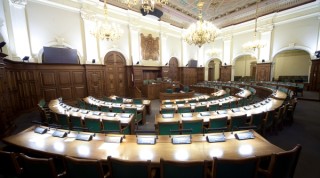
Latvia’s 12th Saeima (Parliament) elections on October 4 brought some unexpected results, while maintaining the dominance of present coalition parties. Although the election was fought in dramatic circumstances with Russia’s invasions of Ukraine and growing threats to the Baltic countries, many parties in the campaign made little mention of Ukraine, concentrating on domestic matters, and rather than an atmosphere of tension a curious lethargy was evident, reflected in the low (59%) turnout of voters.
The ‘winner’ of the elections – just – was also the previous largest party, the Moscow-leaning Social-democratic party Harmony (Sociāldemokrātiskā partija Saskaņa), but this time with 24 deputies in the 100-member Saeima, a drop of 7. The party had resolutely refused to condemn Russia’s actions in Ukraine or cut its ties with Putin’s United Russia party, thereby losing voters but also seeing part of its traditional supporters simply not coming to vote. Just behind Harmony, with 23 deputies came Unity (Vienotība), the previous leading coalition party, an increase of 3 but with some leadership problems.
Also gaining in the elections were the Greens and Farmers Union (Zaļo un zemnieku savienība – ZZS) with 21 deputies, a gain of 8; ZZS is a traditional party with a very divided identity – it is closely allied to Latvia’s timeless oligarch Aivars Lembergs in Ventspils, but also has a very loyal base of farmers and small businesspeople and a very pro-national stance on many issues. The National Alliance (Nacionālā apvienība – NA ) also gained 3 seats to now have 17, being the party most vociferous regarding Russia.
Much of these gains were made at the expense of the Reform Party, the hastily organised grouping after the previous President Valdis Zatler’s initiative to dismiss the Saeima in 2011, and which had 22 seats, but which had since disintegrated.
Unity, ZZS and NA formed the previous coalition, and are widely expected to form the next, but other events showed this would not be business as usual. For a start, the previously dominant Unity ran into severe leadership problems: Latvia’s not always easy to understand electoral system is a proportional representation system: Latvia is divided into five electoral regions, and within each region a party gets the number of deputies proportional to its vote, but with a proviso that it gains 5% of the vote overall to get any deputies at all. Voters thus vote for one party and its list, but within their vote they can select out from among the candidates on the party’s list – voters can put a plus – “+” against an individual candidate’s name which promotes that candidate up the list, or can strike out a candidate, thus demoting them in the list. Unity had its leader and former speaker Solvita Āboltiņa crossed out by sufficient party voters in the western region of Kurzeme, and lost two other ministers as well. Āboltiņa is a strong and feisty woman, and though her professionalism cannot be doubted she was perceived as arrogant and a controller. But more was to come, to which we return below.
New parties in the Saeima
Business cannot continue as normal also because two new parties have entered the Saeima in these elections. One was a party that promoted itsef as a “saviour’” party (Latvia has these regularly) with an extraordiary name which may be translated as ‘For Latvia from my heart’ (No sirds Latvijai – NSL), created by the former Government Auditor Ingūna Sudraba. In her work she established a solid reputation in uncovering many irregularities and corrupt practices, them came into politics but with an increasingly curious profile – she is close to many Russian oligarchs and even figures in the Russian security service. And her offered policies were vague and poorly articulated, but she gained a populist following, pointing to poor government practices that she vowed to change. Some saw her as a pawn of Moscow, some saw her as naive. She gained 7 seats.
However, the big surprise came from elswewhere: the Latvian Regional Alliance (Latvijas reģionu apvienība – LRA) was formed by provincial representatives, disgruntled both with government policy on regional matters, and with ZZS , the traditional regional party. They found a very representable figurehead in Mārtiņš Bondars, former head of President Vīķe-Freiberg’s office, and slowly gained support to finally pick up a surprising 8 seats, also providing the real highlight of the election. While most of their deputies are the respectable regional figures one may expect, one candidate was the very opposite – Artūrs Kaimiņš is a young Riga actor, radio announcer, flim maker and general anarchist, publicly criticising everything the government does, engaging in bizarre stunts, most recently writing to the European Commission warning them to be careful of former Prime Minister Valdis Dombrovskis’ personal ambitions, as Dombrovskis was angling for a position there! Kaimiņš offered his candidature but the LRA brains trust put him in his place, as 35th on the list of candidates for Riga, where realistically the party could have hoped to win only one or two seats.
Readers of Latvians Online will then be interested in how Kaimiņš went from 35th to number one, and become a deputy: he did it of course through social media, directly addressing the young (no other party in Latvia has ever thought of that!) and interestingly doing it both in Latvia and outside – the many Latvian citizens outside Latvia are allocated to the Riga electorate, and norrmally have little influence on the result. Yet Kaimiņš targeted younger Latvians in Europe who follow Latvian social media, with remarkable results: while most Latvian voters in Western Europe vote for either Unity or the National Alliance, Kaimiņš got the LRA up as the winner in no less then 13 polling places outside of Latvia (including Dublin, Manchester, Birmingham, Bergen, Bradford, Peterborough and Rejkjavik,) and was second top party in half a dozen others including Oslo (by one vote less), Aberdeen, Stockholm and the Hague. And this avalanche of votes and pluses from outside Latvia had tangible results – on the Saturday night the electoral commission’s first solid provisional results gave LRA 7 and Harmony 25 deputies, but as the votes came in from overseas the tide shifted, with LRA picking up the last seat in Riga from Harmony. Anarchy has not been a significant theme in Latvian politics since, say, 1905; it has now returned in novel form. It seems Kaimiņš drew in many younger disaffected voters who may not have participated otherwise; and who did not go to the populist NSL.
Coda
But finally, returning to the big players, the demise of Unity’s Āboltiņa was in strong contrast to the fortunes of Unity’s parliamentary faction leader Dzintars Zaķis, who had become notorious for cheating on taxation and having dubious connections to various oligarchs; at the same time he was useful to the party for kicking heads and doing deals with the Big Boys. Well, in his region of Latgale, he had no worries, ethical matters seem not to weigh heavily on the voters’ minds, and by getting more pluses Zaķis moved up the party list in Latgale from third to first. But, just to show there was cosmic as well as earthly justice in these elections, Zaķis has since been accused of buying votes, paying people to give him a plus. There is considerable interest in the outcome of this development.