Permanent presence of NATO forces in Latvia would strengthen Latvia’s national security

If the Saeima of the Republic of Latvia wants to prove that it truly understands the latest developments in Ukraine and wants to prevent the occurrence of similar events in Latvia, the Statement on Russia’s Aggression in Ukraine adopted by the Saeima on 6 March should not remain merely declarative.

Therefore, after adopting the Statement, both the Saeima and the government need to take extraordinary measures on a national level to prevent potential threats to Latvia’s national security. It is well-known that international law and practice allow countries to take extraordinary measures, where national security is under threat.

During an extraordinary meeting held on 3 March, the parliamentary group and Board of the National Alliance adopted a decision to urge the government of Latvia and the Saeima to take determined measures and consider this matter at the cooperation council of coalition parties. The proposals are as follows:

1. To limit pro-Kremlin war propaganda in the Latvian media;

2. To suspend issuance of residence permits to citizens of the Russian Federation;

3. To boost the defence capacity of the Latvian National Guard and to increase its involvement in strengthening domestic security;

4. To take all possible measures to ensure permanent presence of NATO forces in the territory of Latvia;

5. To ensure maximum transparency of foreign financing to NGOs and, if necessary, to set limitations.

Additional information on each proposal

1. Ways to limit pro-Kremlin war propaganda in the Latvian media can be sought also outside the media space, namely, among national security tools. To enable early detection of anti-democratic military aggression propaganda, it is necessary to ensure regular media monitoring. The National Alliance urges the National Security Council and the National Security Committee of the Saeima to seek possible solutions. Not only the Ministry of Defence but also the National Security Council and the National Security Committee need to explain to the Saeima and to the public the essence and objectives of the war propaganda. Monitoring and evaluation of the Internet environment and other types of mass media should be conducted centrally.

If the Saeima condemns the aggression in Ukraine, it should also strive to curb the pro-Kremlin aggression against Ukraine in the media. Aggression in the media should be analysed on a regular basis. Latvia has to act quickly instead of having a provincially backward response to the war propaganda broadcast in the media. It is clear that Latvia needs a media policy.

2. The Saeima has held a lot of debates about the necessity to suspend issuance of residence permits to citizens of the Russian Federation.  Backing off from the proposal of the National Alliance on this matter would mean facilitating a repeat of the current Ukrainian scenario in Latvia.

3. After the events in Ukraine, there can be no more discussions about whether to increase military spending. This, of course, must be done immediately and to the sufficient extent. At the moment, the share of spending for defence might be increased up to 1% of GDP with an upward trend.

It is necessary to boost the defence capacity of the Latvian National Guard and to increase its involvement in strengthening domestic security. Its functions should be clearly defined. The state should provide an opportunity for its people to volunteer as reservists in order to develop their civil-defence and military skills, for example, by offering every year a two-week long state-funded voluntary training supported by employers.

The National Security Council should have a plan for protecting the state from subversion similar to what is going on in Ukraine or to what happened in Georgia.

4. The Latvian government needs to take all necessary measures to ensure permanent presence of NATO forces in the territory of Latvia.

It is known that, upon the request of the Baltic States, the U.S. will provide the presence of another six fighter jets for air policing in the Baltic States. That was one of the points on which the National Alliance insisted during the Cooperation council of coalition parties on 3 March, when speaking about the permanent presence of NATO forces in Latvia. It is hard to understand why the coalition partners rejected this proposal of the National Alliance if the Minister for Defence later on supported it with his actions.

5. It is necessary to ensure maximum transparency of foreign financing to NGOs and, if necessary, to set limitations. State-funded NGOs cannot be real NGOs. Such organisations are called GONGO (government-organised non-governmental organisation). In Latvia these are NGOs established by the government of another country, namely, pro-Kremlin associations, that become active in this country whenever issues such as the Latvian official language, citizenship or state continuity etc. are being addressed. It is necessary to regularly monitor the financing of those NGOs what are in attention of the state, to publish pertinent reports and take steps to reduce the Kremlin’s impact in Latvia, so that Latvia’s sovereignty and democratic foundations are not undermined by those hiding behind the lofty name of NGOs.

I hope that events in Ukraine have been an eye-opener for everybody. It is high time for the Saeima and the Latvian government to act in order to prevent Ukraine’s current reality from becoming Latvia’s.
vācietis

image

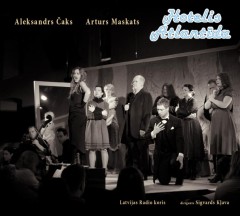
The poetry of Latvian poet Aleksandrs Čaks, with its vivid descriptions of the city of Riga – both the bright and not so bright characteristics, featuring characters such as prostitutes, drunkards, even cockroaches, might translate well to a theatrical setting, one might think.

In fact, this idea became reality a few decades ago, when Latvian composer Artūrs Maskats wrote melodies for a number of Čaks’ poems, performed at the time by Ivars Kalniņš. The years went by, and the idea to bring these songs back to public life blossomed and Maskats began work on more songs with lyrics by Čaks.

These new songs, along with new arrangements of the older songs, became the project Hotelis Atlantīda, a musical/theatrical event that featured the Latvian Radio Choir (musical director Sigvards Kļava) and was premiered in April of 2012, and was directed by Viesturs Kairišs (who also was the author of the libretto).

A CD of the same name has been released, and now listeners can now be brought back in time to the Riga of the past, with not just its many seedy elements, but also with many charming and quaint aspects that may have been lost over the years.

Besides the texts by Čaks, much of the atmosphere is provided by the band, including Aldis Liepiņš playing the piano, Indulis Cintiņš on violin, Jānis Stafeckis on contrabass, Ivo Krūskops on percussion, as well as both Kārlis Bimbers and Iveta Romancāne playing the accordion. The instruments are essential to the action and atmosphere on Hotelis Atlantīda, and deserve much of the credit for the success of the work – for example, the sorrowful violin in “Klaidonis”, complementing the bitter words of the titular wanderer, gloomy laments like “Rūgtas dziesmās es izkliedzu sirdi” (In bitter songs I scream out my heart).

Though Maskats provides the melodies, many of the actual arrangements were done by other composers, and many of Latvia’s brightest composers were involved in this process – including composers such as Andris Sējāns, Anitra Tumšēvica, Emīls Zilberts, and Jēkabs Nīmanis.

The distinctive baritone of Ivars Cinkuss is one of the many stars in Hotelis Atlantīda, appearing on six of the numbers, providing what one might call the ‘soul’ of the performance, with the rueful prayer ‘Lūgšana’, or the plaintive ‘Vai varu tev pie kājām likt’, as well as the bitterly sentimental ode to the city outskirts in ‘Nomalei’, bringing the necessary haunted disenchantment that many of Čaks’ characters exhibit.

Singers Kristīne Barkovska and Agate Burkina give life to the world weary, cynical Rīga prostitutes depicted in the song “Prostitūtas dziesma”, singing about their various types of clients, and “tikai plaukstošs veikals labs” (only a blossoming store is good).

Perhaps one of Maskats’ most famous works is his setting to music of Čaks’ poem, the ode to Riga ‘Rīgai’. Celebrating both the ‘old’ Riga (“Rīga, sirmā Rīga”) and the ‘new’ Riga (“Jaunā, skaistā RĪga”), this song, though originally written as a song for a solo singer, has since become a popular choir work, and a perennial favorite at song festivals based around the anniversary of Riga. The Radio Choir provides both the necessary tenderness and reverence for this moving tribute to the Latvian capital city.

Composer Maskats, who has been working with theater music for much of his career, is clearly an ideal choice for adapting the works of Čaks to music. As much of his music has a dramatic, and yet romantic, aspect to it, the music of Maskats brings these characters of Čaks to a vibrant life – the music provides additional personality aspects, making them living and breathing beings that are also given form by the singers of the Latvian Radio Choir.

The combination of Aleksandrs Čaks’ poetry, Artūrs Maskats’ music, the Latvian Radio Choir’s singing and dramatic talent (under the direction of Sigvards Kļava) is a potent combination not to be missed. Čaks’ characters and images are vividly portrayed in their full colorful, if a bit scruffy, glory. Hotelis Atlantīda at once not only displays the talents of the singers of the Latvian Radio Choir, but also of composer Maskats, and, of course, the unique ability of Aleksandrs Čaks to breathe into existence the denizens of Riga, no matter what walk of life they are from.

The Latvian Radio Choir web page: http://www.radiokoris.lv

The Latvian Radio Choir on Facebook: https://www.facebook.com/pages/Latvian-Radio-Choir/122477347765305

Details

Hotelis Atlantīda

Latvian Radio Choir

Latvijas Koncerti,  2013

LK-019

Track listing:

1. Vai varu tev pie kājām likt

2. Lūgšana

3. Spēlē, spēlmani

4. Viesmīļa dziesma

5. Matrozis laķenēs

6. Noktirne

7. Šansons III

8. Pašpuikas dziesma 2

9. Nomalei

10. Nomaldījies

11. Šansons I

12. Klaidonis

13. Prostitūtas dziesma

14. Pašpuikas dziesma

15. Šansons II

16. Meitene sērās

17. Romance

18. Puteklis

19. Divi vientuļi

20. Rīgai

21. Sirds

22. Rīga

Egils Kaljo is an American-born Latvian from the New York area . Kaljo began listening to Latvian music as soon as he was able to put a record on a record player, and still has old Bellacord 78 rpm records lying around somewhere.

Bobsleigh Silver Ends Drought

image

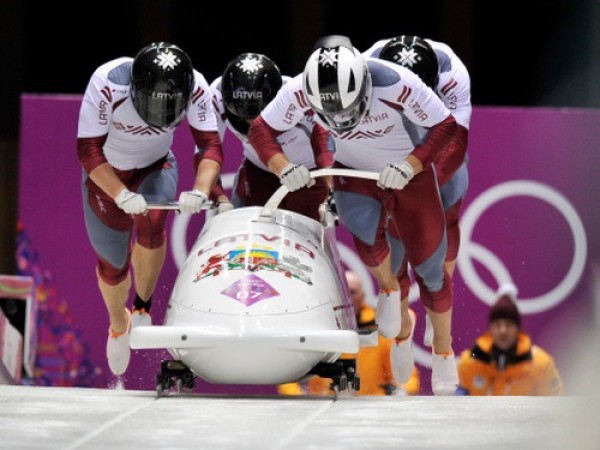
Bobsled foursome, headed by Oskars Melbārdis. Foto: Romāns Kokšarovs, Sporta Avīze, f64

It was a long time coming but the Latvia’s 4-man bobsleigh crew consisting of 26 year old pilot Oskars Melbārdis and crew members Daumants Dreiškens (29), Jānis Strenga (28) and Arvis Vilkaste (24) brought home a silver on the last day of the Sochi Games. They finished behind Russia by 9/100th of a second. After a shaky 1st heat when they finished 5th, the crew nailed it on the second when they shot up to 2nd place and kept that position through the 3rd and 4th heats.

Twenty six years ago at the Calgary Olympics in 1988, a four man crew piloted by Zintis Ekmanis consisting of three Latvians and a Russian, and a two man crew piloted by Jānis Kipurs, brought home a gold and a bronze. Unfortunately the medals went to the Soviet Union. Four years earlier in Sarajevo, Zintis Ekmanis piloted a 2-man sled to a bronze.

When the Soviets decided to take up bobsleighing in 1980 they leveraged the luge tradition in Latvia and Latvians were front and centre in Soviet bobsleigh. There were high hopes that the medals would continue after Latvia regained independence. That was not to be the case. Bobsleighing is an expensive sport. Sleighs are high tech and cost over $100,000 each. Latvian bobsleighing struggled as the country transitioned to a free market economy where state funding had to be replaced by private sponsors.

The luge and skeleton are less expensive and Latvian athletes in those sports were able to eclipse the bobsleighers. But over the last few seasons, the bobsleighers were starting to podium on the World Cup circuit and they finally delivered on February 23 at Sochi.

Meanwhile Latvia’s second crew consisting of Oskars Kibermanis, Raivis Broks, Helvījs Lūsis and Vairis Leiboms finished 14th. Only twenty years old, pilot Kibermanis will be a future force in Latvian bobsleigh. Earlier in the week during the two-man bobsleigh competition, pilot Oskars Melbārdis and brakeman Daumants Dreiškens came in 5th while Kibermanis and Leiboms finished 16th.

Latvia’s flag bearer at the Sochi Olympics closing ceremonies is bobsleigher Daumants Dreiškens. He has been competing in bobsleigh since 2003 and was chosen by the Latvian Olympic Committee as an athlete who sets the example for others through his character, work ethic, perseverance and teamwork.

Perhaps the only black mark for Latvia at these Olympics was that hockey player Vitalijs Pavlovs tested positive in random doping tests conducted on four players from each team after every game. Ostensibly it was a food supplement. Pavlovs plays for Dinamo Riga in the KHL.

Top 10 finishes for Latvia included a 4th place finish by Tomass Dukurs in the skeleton just shy of a medal, a 5th in two-man bobsleigh, 9th place by Andrejs Rastorgujevs in the 12.5km biathlon pursuit, 10th place by Mārtiņš Rubenis in the luge and another 10th place by Oskars Gudromovičs and Pēteris Kalniņš in the men’s double luge. As a footnote, Latvia pocketed one of only three goals scored in hockey against Canada as the Canadians advanced and eventually won gold against Sweden.

With two silver and two bronze medals, this is Latvia’s best Winter Olympics showing topping the two medals picked up in 2010 at Vancouver. Latvia is proving to be a sliding power and along with Russia and the United States were the only countries with medals in all three disciplines, the bobsleigh, luge and skeleton.

Russia won the official medals standing where a gold counts more than a silver and a silver more than bronze. Norway came second and Canada third. The United States came second in the unofficial total number of medals count regardless of colour. Latvia placed a distant 23rd with 26 out of 89 countries at Sochi picking up medals.

But Latvia was the only one of the three Baltic countries to medal.