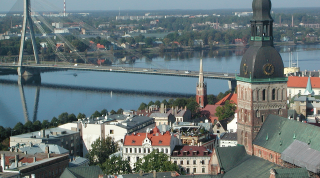
Whew! The Latvian capital city of Rīga just finished being the European Cultural Capital, and the very next day all of Latvia became the presiding country of the Council of the European Union for the next six months! This is not an elected position, it comes around on a rotating basis once every … let me see, 28 member states, so once every 14 years. There has been mumbling in Brussels from time to time about the idea that this is rather silly, shifting the centre of operations, as it were, from Rome to Rīga and then on to Luxembourg City, as will be the case this time, but for the time being, the system is what it is.
In practical terms, this means that for the next half-year, Latvia will be able to set at least some of the agenda for the EU. Our government has said that priorities will include employment issues, further steps to overcome the consequences of the recent financial crisis, digitalization issues, the EU’s role in human rights defence across the globe, and particularly the European Union’s Eastern Partnership Programme, which seeks to develop relations with Eastern European countries that are not in the EU, but might want to become members in future. During the course of the presidency, our government ministers will become chairs of the relevant sectors at the EU level. A number of high-level meetings will be held, including a meeting of European and Asian education ministers, a summit meeting on standardisation in the EU, and particularly the Eastern Partnership Summit, which will bring together leaders from EU member states, as well as from the partnership countries (Armenia, Azerbaijan, Belarus, Georgia, Moldova and Ukraine). Fingers crossed that our ministers will be up to the task, seeing as how some of them are brand spanking-new ministers who only took office after last autumn’s parliamentary election. Fingers more precisely crossed that the same will be true of our civil servants, who will be doing the behind-the-scenes work to make sure that all proceeds smoothly.
(A parenthetical note, if one may: The centre of operations for the Latvian presidency will be at our comparatively brand spanking-new Latvian National Library, which means that for the duration, visitors to the library will have to enter through the back door, and they will find that much of the library is closed to them; be that as it may, if you happen to be in Latvia during the next six months, visit the library anyway – it is an architectural glory.)
The Eastern Partnership issue bears particular consideration for Latvia’s presidency, because, of course, to our East (and South) are not only the aforementioned EU member wannabes, but also a big country which would be just as happy to see the said wannabes far away from the EU (to say nothing of NATO). I refer, of course, to Russia, which is a country that appears to have endless stores of mischief and outright aggression in relation to what the Kremlin continues to consider its “sphere of influence” in geopolitical terms. Readers will know what this means. Of the aforementioned six countries, three, or one-half, have territory that is occupied by Russia either supposedly permanently (Abkhazia and South Ossetia in Georgia, Transnistria in Moldova, Crimea in Ukraine) or at least temporarily (the Donbas in Ukraine). Moscow is betting, and not without reason, that the EU will not admit for membership any country that has outstanding border issues with another. Here it bears remembering that the absence of a border treaty between Latvia and Russia at one time was seen as a potential stumbling block for our own membership, though in the event the treaty was only ratified three years after Latvia joined the EU and NATO.
What might Putin do? I would say God only knows, but I suppose that even God with all of his omniscience doesn’t have a clear sense about this. It is clear that the sanctions that were imposed against Russia by the West in the wake of Putin’s grand adventures in Ukraine have started to bite and bite hard. Readers will know that over the past month or two, the value of the Russian rouble has basically collapsed. International companies that operate in Russia have found themselves having to change the price of their goods and services, as denominated in roubles, once a day or even more often. Inflation has been rising rapidly. Capital outflow from Russia, active for some time now, has turned into a raging torrent. The embargo on Western food products that Moscow imposed in response to the sanctions has in many cases resulted in food shortages. Russian leaders may smirk about visa restrictions that have been established on them, but it is clear that in many cases they are inconveniences for grand poohbahs who are no longer able to visit their villas in the South of France or whatever.
Now, in a normal country, all of this would turn public opinion against the ruling regime. In Russia, however, the Kremlin’s nearly total monopolisation of the mass media, and particularly the broadcast media, has ensured an endless flow of mendacious propaganda to suggest that Russia has done nothing wrong, the problem is that the wicked West has always conspired against it with the aim of bringing it to its knees. Putin said so in a speech a while back – even if Russia hadn’t begun to meddle in Ukraine, he said (thus, incidentally, more or less admitting something that he had steadfastly denied – that Russian troops are actually in Ukraine), the West would have found some other excuse to do what it is doing. The current government in Ukraine is made up of fascists. All of the bloodshed in Ukraine has been the doing of the said fascists (Russian TV has gone so far as to show grotesque pictures from conflicts in the former Yugoslavia and Chechnya and claim that they are from South-eastern Ukraine). And so on.
With respect to the Eastern Partnership countries, it is not just Russia’s occupation of land. There is also the so-called Eurasian Union that has been Putin’s baby for the past decade and more. Initially established by Russia, Kazakhstan and Belarus on the ruins of the old Confederacy of Independent States, the union is intended to be a counterweight to the EU. Readers will remember that it was specifically former Ukrainian President Viktor Yanukovich’s decision to turn toward the Eurasian Union and away from the European Union that led to the protests that quite quickly caused him to close down shop and flee like the sinking-ship rat that he was. Certainly the new Ukrainian government has no interest whatsoever in re-joining the clutches of the Russian bear. By contrast, Armenia has signed up to the Eurasian Union, and its membership took effect on January 1 this year. It will be interesting to see what the Armenians will have to say when they turn up at the Eastern Partnership summit in Rīga.
There is also, of course, the issue of energy. Moscow has never been shy about using its natural gas supplies as a geopolitical tool of blackmail. True, this tool was more effective back when the price of oil was high. Now that it is very low, the room for manoeuvre for Gazprom is rather limited, because Russia’s national budget, such as it is, is predicated on the assumption that oil prices will be high. Still, it is worth noting here that last autumn, amidst much pomp and circumstance, Lithuania opened a new liquefied gas terminal that, crucially, will be appropriate for receiving so-called shale gas from the United States. Latvia’s government, by contrast, has spent years discussing whether it might possibly start to analyse the eventuality of perhaps considering a discussion about whether to debate the issue of maybe building a terminal of its own and then to ponder where to put it … that kind of thing. Enough said.
Finally, there is the Russian military. Readers will know that in recent times Russian warplanes have been regularly skirting and sometimes entering the airspace of NATO member states such as Latvia. The alliance has been forced to regularly scramble its own warplanes to go and chase the intruders away. This is a potentially dangerous game of one-upmanship. It is accompanied by a lower-level so-called hybrid war, which includes the aforementioned mendacious propaganda (Russian television channels are freely available here in Latvia, too, and it is worth noting that at least a few residents of our country have taken it to mean that they, too, should go to South-eastern Ukraine to fight against the “fascists”), as well as cyber-attacks of various kinds. It was no accident that the EU decided to place its main cyber-security centre in Estonia, which suffered a vast cyber-attack, almost certainly if not from the Kremlin, then certainly with its blessing, after the so-called “bronze soldier” riots.
The $64,000 question here is whether Vladimir Putin is crazy enough to launch a real conflict against NATO. There is a body of thought in Russia itself that suggests that messing around in places such as Ukraine and Moldova will not scratch the dictator’s itch, because such countries are not in the EU or NATO, and thus Russia’s intervention there does not affect Western interests directly. The Baltic States, which are in the EU and NATO, are a different matter, and they may prove to be too tempting a piece of fruit for the Kremlin to resist.
I doubt that this is true. After years of dilly-dallying about Baltic security plans, NATO in more recent times has been saying more and more clearly that if necessary, it will take all necessary steps to defend the three republics, as provided for in the famous Article 5 of the NATO Treaty. There are boots on the ground here already, so to speak – American and other soldiers who are here for the duration. Plus, of course, for some years now NATO has been providing the warplanes that are necessary for monitoring Baltic airspace, something for which we can be grateful not least because Latvia, of course, has no warplanes of its own. Far from it. This, among other things, has, with increasing urgency, brought up the issue of Baltic defence spending. Estonia spends the requisite 2% of GDP. Latvia does not and, even with all that is going on in Ukraine, will not until 2020 at the earliest. Once again – enough said. Readers may roll their eyes if they wish.
All that said, I do not believe that Latvia needs to fear for its security. It is likely that during the EU presidency Latvia will face various kinds of harassment from Russia, as Lithuania did do when it held the presidency during the second half of 2013. But Russia at this time is a wounded bear. The occasional swipe of a paw may be all that it is capable of right now. And I say again – NATO is standing guard. Amen.
In domestic politics, a big event this year will be a presidential election. Readers will know that Latvia’s president is elected by Parliament, not the public, and even though the new Parliament has a number of parties that wish to institute a popularly elected presidency, there is little chance that this will happen in time for the election that is to take place in June (and, for various reasons, it would not be a good idea even after that; that would be the topic for a separate column). The incumbent president, Andris Bērziņš, has not yet said whether he will seek a second term in office. He has been a mediocre president, I must say. No great orator. An excessive focus on business issues at the expense of human rights. Occasional weirdness (as in public ruminations a while back as to whether there really is any reason for Latvia to spend the money that is necessary to take over the EU presidency, as if this were not an automatic process). I believe that it would be just as well if he decided to retire, though that would mean the usual political ruckus in Parliament to come up with an alternative.
Finally, socially conservative readers may wish to skip this paragraph, but also in June, Rīga will host the European LGBT Pride event, Europride. Thousands of people are expected to visit the Latvian capital for the event, and although homophobic types have already been trying to organise a protest of opposition, the event will occur, and it will be a proud and magnificent event. All for the good.
All in all, I believe that Latvians can feel secure about their motherland during 2015. The economy is doing OK, just OK. The 2015 national budget is perhaps predicated upon excessively optimistic expectations of growth, but there will be growth. As noted, security in the primary sense of the word is abetted by the world’s most powerful military alliance. What remains to be hoped is that our politicians will simply demonstrate common sense in response to the various challenges that they will face. Of course, as always in politics, that is easier said than done, but fingers crossed anyway.
What can you do if you live in Chicago or London or Perth or Walla Walla? If you are religious, pray for Latvia. If you have the wherewithal, you can help financially. The Vītols Foundation, for instance (www.vitolufonds.lv), administers hundreds of scholarships to help needy students pursue a higher education. You can set up one of your own if you wish.
But above all, come visit! Not right now. It’s sloppy and messy outside with snow and especially slush. But think about it during the summer. I know that the American Latvian Association will once again be running its “Hi, Latvia” programme for American Latvian teenagers. I know this because one of my nephews will be one of those to take part. Why not come along with your kid? If you’ve never been here, I recommend it. Architecture fans will be agog at the variety of architectural styles, particularly Art Nouveau, that can be seen in Rīga. Countryside types can visit hundreds of guesthouses and inns all across the country (see www.laukucelotajs.lv for a list). It is a sad fact that during the summer, most of Latvia’s cultural institutions are shut down, but if you come in the spring or the autumn, there will be hardly an evening when you will not be able to attend a world-class theatrical or musical performance of one type or another. Come. You won’t regret it.
And keep on reading “Latvians Online.” Keep on reading Latvian news portals. Be up on what’s going on here, particularly if you are a citizen of the Republic of Latvia and plan to or have been taking part in elections. All of us have only these 64,569 square kilometres (almost precisely the same size as West Virginia in the United States) of cherished motherland. For all intents and purposes, the fact that ours is the independent Republic of Latvia is something of a miracle. It could all have gone differently both in the early 1920s and in the wake of the collapse of the Soviet Union. We can all work to make it a better place. Of course, that is easier done if one actually lives here (in September it will be 25 years since I fetched up on these shores – where does the time go?), but, as noted, there are things that you can do, too. You can polish up your Latvian language skills, for instance. Yes, it’s not the easiest language in the world what with all of the cases and declinations and diacritical markings and what not, but knowing Latvian will allow you and your friends to talk about Americans or Canadians or Australians without them knowing what you’re saying. That’s something. And definitely make sure that your kids learn the language. Three hours on Saturday at the local Latvian school and six weeks at a summer camp won’t do the trick if you don’t lay the foundation at home. Perhaps one day your children will want to live and work in Latvia. That won’t work without the language. Don’t deny them the opportunity.
Happy New Year, everyone! It is wonderful that our country is free.
Kārlis Streips was born in Chicago, studied journalism at the University of North Illinois and University of Maryland. He moved to Latvia in 1991 where he has worked as a TV and radio journalist. He also works as a translator and lecturer at the University of Latvia.