Readjusting the school merry-go-round

Why jump on the Latvian school merry-go-round? In a some parts of the United States, Canada and Australia, as well as a few cities in the United Kingdom and Sweden, kids of Latvian descent—several hundred, maybe, in total—still attend Latvian Saturday or Sunday schools to learn the language and culture of their parents and grandparents.

Why? Their parents—who were, for the most part, born outside Latvia in the 1950s to the 1970s—still consider this a priority and are prepared to make the commitment of devoting their childrens’ (and their own) days off to this cause.

But why? Each parent has an individual answer to this question. The collective reason, however, is no longer a united one. Latvia is now a free country. Anyone of Latvian descent is now free to move to Latvia and raise their children there. No one will stop you. But many of us still remain in the countries where we were born, yet we want to raise our kids with the language and culture of our forefathers.

Gone are the days when stepping on the "Latvian carousel" was carried out as a duty to the homeland that was oppressed by the Soviets, when learning the language and culture was a "natural" thing: most of your friends and relatives were Latvian, and teaching the kids about their parents’ homeland seemed logical and important.

This present generation of parents now sending their children to Latvian school was born in the United States, Canada, Australia, the United Kingdoom, Germany or Sweden. For many, their Latvian identity was a small part of their whole persona. They were raised with the values of their country of birth. They, on the whole, spent most of their time with friends from their local school and, later on, their work community. They have married either local non-Latvians or have spouses of Latvian descent but who also were not born in Latvia.

Yet, some of these devoted 30- and 40-something Latvians around the world still wish to continue to devote part of their weekends to Latvian activities. The strange sense of "duty" is still there, but in varying degrees, of course. What is this duty to? Sometimes to their parents. They feel they would have let their kids’ grandparents down if they don’t make some sort of attempt at sending them to school. Some hope the school will teach them something because it’s difficult at home. Often, if their spouse does not speak the language, their children feel more comfortable and find it much easier speaking the language of the country of their birth. Others want to pass on the language and culture of their forefathers to their children. And still others can’t imagine not sending them to Latvian school because that’s what they had to do, so that’s what their kids are going to have to do, too!

After all, Latvian is not a language that parents would naturally choose as one that could be beneficial to their child and come in handy when travelling or for doing business in their future career. Nor is it considered as one of the classical languages, like Latin or ancient Greek.

What, then, should these children be learning at Latvian school, bearing in mind that we’re talking about a few (at the most four) hours per week?

The old school of teaching says we should teach Latvian grammar, literature, geography, history, and a smattering of folklore (songs, dancing, traditions).

Is this sort of a curriculum still relevant to second- and third-generation Latvian children born and living outside Latvia? Is the same style of teaching that we were brought up with on Saturday or Sunday mornings still an effective way of teaching the language and culture?

I would argue that the curriculum should reflect the changed perception of Latvia held by the parents, pupils and those teaching the language.

What is these kids’ perception of Latvia? They don’t have parents (or even grandparents) who can share with them their experiences of life in "Ulmaņa Latvija" (Latvia when it was led by Kārlis Ulmanis in the 1930s) and in their minds be able to conjure up the romantic or sentimental longing for a "fatherland." The parents and grandparents of this generation of children have a more objective view of Latvia based on either personal trips to Latvia in the past 10 years or news about life in Latvia today gleaned from printed and online media, as well as other travellers. And if there is a small group of grandparents who were children in Latvia before they emigrated during the Second World War and who still remember the Latvia of the 1930s, then more often than not, they have visited Latvia in the past decade and have a realistic view of Latvia today.

This current generation going through Latvian schools outside Latvia is:

  • vastly different to previous generations in terms of upbringing, expectations, knowledge about their Latvian heritage and the Latvian language, and blood nationality (many of these children are born into families where one parent is not Latvian). This means that merely using the textbooks used by Latvian children 20 or 30 years ago would not be the most effective way of teaching this subject.
  • vastly different to the generation of schoolchildren currently going through the education system in Latvia. This means that the educational methods employed in Latvia today cannot be simply transferred to the schools that are teaching the language and culture outside Latvia. And merely buying textbooks used in Latvia and presuming that these by themselves will solve all teaching problems would not suffice.

What to do?

First, teach the language (ideally, where resources permit, at two separate levels: to those who already speak Latvian in a home environment and to those who do not), incorporating the wide variety of resources available from Latvia today: books, magazines, newspapers, audio tapes, CDs, videos and anything else that teachers can utilise to make their lessons more interesting. A wealth of resources is available. It only takes a bit of organising to get them sent to your city. The literary classics should be taught to the children, bearing in mind their understanding of the language. If their understanding is limited it would be much more beneficial to create an interest in the written word by introducing other, more easily digestible literature, rather than forcing them to read works that will only create resentment within the children.

Second, teach the culture. This is an integral part of the process of learning to identify oneself as a Latvian. Give the children an understanding about the rich cultural traditions that they have inherited from their ancestors—folksongs, folkdances, festivals, traditions—and teach them to admire the uniqueness of this culture. This part of their education should be a particularly "fun" part. Most of the folklore can be taught in a hands-on way to really bring home the concepts and understand that the folklore was all tied in with the lifestyle and world view of their ancestors.

Third, teach the history. An important part of being Latvian is understanding what Latvians have gone through in the past, knowledge that can help one understand Latvia’s current trials and tribulations. The history should be taught, if possible, not through textbooks, but through literature, art, videos, personal documents and oral history.

Fourth, create opportunities for children to participate in activities where the whole school takes part. By feeling that they are part of a whole community, not just a single class or just their family, they hopefully will grow to enjoy the experiences they have had with "the Latvians," not just base their judgment on the classroom experience. Latvian summer camps play a major role in this process.

And, fifth, create opportunities for children to visit Latvia, if only for short periods of time. This will consolidate all they have learnt, and meeting with Latvians from Latvia (particularly children) would make the "Latvian experience" much more tangible and give a greater sense of purpose to the learning process.

Emphasis should be placed on learning everything in a fun way. Don’t forget that at their weekday schools children are taught subjects with a wide variety of audiovisual materials. Why not make use of every possible Latvian resource you can lay your hands on to make the learning process memorable and fun? Unfortunately, it’s not possible to use Latvian computer games as resources as they are hard to come by. However, teachers could alert their pupils to the fact that the Internet opens the door to hundreds of Latvian Web sites, some of which would be quite interesting to the children. Why not make use of the Internet as the basis for a research project? The kids would be surprised and delighted with what they can find!

I must stress that this is my personal opinion, based on my experiences within the Latvian community in Australia. I have attended Latvian Saturday school from age four to matriculation level. And I now have a five-year-old daughter who has just started attending Latvian school on a weekly basis on Saturday afternoons.

What is your view? Do you agree with this? Or do you have any other suggestions? What was your experience in the Latvian language schools of the 1950s, ‘60s, ‘70s, ‘80s and even 1990s? Are you currently teaching in a Latvian school outside Latvia? Do you have any teaching tips or successful methods you would like to share with others? By pooling our ideas together and learning from each other we can find better solutions to age-old problems and make our trip on the merry-go-round a bit smoother.
Daina Gross is editor of Latvians Online. An Australian-Latvian she is also a migration researcher at the University of Latvia, PhD from the University of Sussex, formerly a member of the board of the World Federation of Free Latvians, author and translator/ editor/ proofreader from Latvian into English of an eclectic mix of publications of different genres.

Like squeezing blood out of a stone?

As I was flicking through a photo album containing photographs of past pupils of the Sydney Latvian School and recognising faces I had known in my childhood, I came to realise that about 80 percent of these faces I hadn’t seen since my days at this school where I learnt to read and write in Latvian on Saturday mornings. I can’t say for certain that this vast majority of my peers has never shown their faces in the Latvian community since their school years. But I do know for a fact that when I visit my hometown and venture into the Sydney Latvian House to attend a cultural performance, I would be surprised if I caught sight of any of those faces (slightly older, but still recognisable I’m sure!).

The same goes for the Melbourne Latvian community—which I am more familiar with now as I have been living here for more than 10 years—and for most Latvian communities in the United States, Canada and other countries where Latvian communities flourished and within which schools were founded and operated for many years.

In most of the major Latvian centres around the world to a greater or lesser degree there is still a handful of active second and even third generation Latvians still interested in maintaining the Latvian language, culture and doing their best to pass it on to their children. These Latvians still view this as a priority in their lives and put in much effort and still devote a great deal of their time to this pursuit. Yet a large proportion of this generation has drifted away from most Latvian community activities and can rarely be seen attending, let alone being involved in, the many organisations that still exist where Latvian communities are still active.

I do realise that it is 50 years since Latvians emigrated to these countries and that it sounds like a big ask for all second-generation Latvians (i.e., those who were born outside Latvia), let alone third-generation Latvians, to retain their interest in things Latvian, yet I still wonder about this phenomenon. Hundreds of Latvian kids, born in the United States, Canada, Australia or the United Kingdom over the past 40 years, have gone through the emigre Latvian education system, have attended these schools on a weekly basis, learnt the language and much about its traditions, spent their summer vacations in Latvian camps, high schools and so forth. Even if only an inkling of what they have learnt remained buried deep in their subconscious, one would like to hope that they would still retain some degree of interest in the fatherland of their grandparents, a task that these Latvian schools had taken on to perform.

Do these Latvians still maintain some contact with other Latvians within a family or social setting? Do they identify themselves as Latvian and maintain some interest in Latvia and Latvians? Have they ever been to Latvia or intend to visit it some time in the future?

A vast majority of these second-generation Latvians have graduated from Latvian school or maybe abandoned their schooling earlier simply out of a lack of interest—not always on their part but more often that of their parents. Their parents and grandparents (or their Latvian-speaking parent) spoke to them in the emigre country’s local language because it was much easier and did not take that much interest in their Latvian schooling. As a result of this lack of support within the family structure, this interest in their Latvian identity was fragile if not even non-existent and there was little hope of breathing life into this identity during these few hours spent at Latvian school over the weekend.

This brings me to the crux of my musings: without the support and interest within the immediate family, there is little hope of achieving much at Latvian school. It would be like squeezing blood out of a stone.

In some cases, even though these Latvians do identify themselves as Latvian and still speak (or understand) the language, their experience at Latvian school may not have been too positive, either at a social level or at the educational level. As this may have been their only contact with Latvians outside their family, the connection with other Latvians was not found and hence the loss of interest.

Another likely reason for abandoning Latvian community activities probably was a lack of interest in these activities or the inability of these activities to fulfill their needs. When you graduate from Latvian high school, what can you do within the Latvian community? You can still be part of a Latvian folk dancing group, choir or theatre troupe, play sport, take part in activities organised by ALJA or LNJAK (or LJAA in Australia, when it was still active) or join a sorority or fraternity (korporācija) if you are studying and others of your age group have joined. But a few years down the track, what then? Most of the Latvian organisations that do still exist are run and attended by the older generation of Latvians who have different perspectives and different life experiences.

Then there is another group of Latvians of my generation who have simply experienced Latvian "burn out." They have participated in every Latvian event under the sun, have danced and sung and played an instrument and organised this, that and the other event till one day they have had enough. They simply want a rest. So they do…and find that immersing themselves in the local (be it American, Canadian, British or Australian) culture is much easier and less demanding.

The smallest percentage of my generation has gone to Latvia to live. These are mostly Latvians who were in their early to mid twenties when Latvia regained its independence in 1991. They had not established themselves in family life or a career at the time and had nothing to lose when they made the decision to try their hand at living in their parents’ or grandparents’ "homeland."

A small proportion of second-generation Latvians appear "lost" only to return when they have had children of their own. These Latvians might come to the realisation that they do want to pass on their heritage to their children, and Latvian school (if it is still operating in their community) is the best place to do this.

As this is not a detailed academic study, I don’t intend to draw any conclusions or offer any solutions. However, I would like others of my generation (those who are 20-50 years old) to contribute their experiences within the emigre Latvian school system. Were you happy with your experiences or do you only remember it as a negative time in your life? Did you get involved in other Latvian activities after you graduated from Latvian school? Do you still speak the language? Do you regret that you don’t any more?

Daina Gross is editor of Latvians Online. An Australian-Latvian she is also a migration researcher at the University of Latvia, PhD from the University of Sussex, formerly a member of the board of the World Federation of Free Latvians, author and translator/ editor/ proofreader from Latvian into English of an eclectic mix of publications of different genres.

Melbourne among top émigré communities

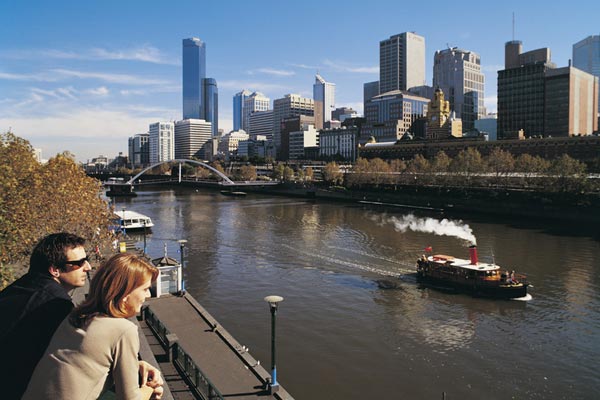
Melbourne skyline and Yarra River

The Yarra River flows past the downtown Melbourne skyline. (Photo by David Hannah courtesy of Tourism Victoria)

Melbourne with its approximately 3 million inhabitants is Australia’s second largest city and, many would claim, its most cosmopolitan one. While white Australians of English and Irish origin form the bulk of the population, among the most noticeable minorities one would certainly have to include Greeks, Italians and, since relatively recent times, Vietnamese.

The Latvians arrive

The main wave of Latvian immigration into Melbourne occurred in 1947-1952, at the very beginning of Australia’s ambitious post-World War II immigration program. Those Latvians were drawn from among a multitude of refugees from East European communism, dwelling since war’s end in Displaced Persons’ camps in the Western occupation zones of Germany, in Austria and in Denmark. The Australian Federal Government’s desire was to beef up Australia’s labour forcewhere at the time there were many unfilled vacancies, especially in the manual labour area. The refugees were looking for a country to go to because of their unwillingness to return, for the time being, to their homeland because it was now dominated by a foreign power, the Soviet Union.

It is estimated that in the 1947-1952 period about 26,000 Latvians came to Australia, with at least one quarter of those ultimately settling in Melbourne. Before this period there were only about 200 Latvians living in the whole of Australia, and only a handful of them lived in Melbourne. In the 1950s Melbourne became the third largest Latvian settlement in what was then known as the Free World, after Toronto and New York. An active social and community life developed.

Although assimilation during the intervening fifty years (largely brought about by ethnically mixed marriages and by many Latvians’ preference not to participate in community activities) has certainly taken its toll, many of the structures developed around the middle of the 20th century still exist, though the actual level of activity within most of them has declined considerably.

Most secular activities are centred at the Latvian House at 3 Dickens St., Elwood, and at the Latvian Relief Society’s “Daugavas Vanagi” quarters at 87 Chetwynd St., North Melbourne. The Latvian House is run by a cooperative committee of the Melbourne Latvian Association, founded in 1949. Both Daugavas Vanagi and the Melbourne Latvian Association have been the backbone of Melbourne Latvian cultural activity and many organisations began their activities under their wing. The cultural activity of the Latvians in the decades following their arrival in Melbourne was quite astounding. Numerous organisations with diverse interests flourished in the 1950s, ‘60s and ‘70s and are still relatively active today: academic organisations, choirs, theatre troupes, schools, folk dancing ensembles, sports associations, scout and guide groups, ski clubs, an arts and crafts federation, various musical ensembles, a press society and many others.

One part of the Latvian House is particularly worthy of mention—the Latvian Library on the second floor. It is the biggest library that houses Latvian books outside Latvia, with a grand total of 17,000 volumes. Its goal has been to collect all Latvian publications published outside Latvia as well as all those publications that mention Latvia and the Latvians. For 50 years the main person behind this mammoth task of collating and cataloging was Lilija Dunsdorfa with a long list of diligent helpers.

Two Lutheran congregations

Two Latvian Evangelical Lutheran church congregations are found in Melbourne, the larger of them, the Church of the Holy Cross, owning its own church building at 40 Warrigal Road, Surrey Hills. Over the past 50 years, the congregation has been a great supporter of Latvian social activity, particularly that of the Latvian youth, even going as far as purchasing a property, Sprīdīši, in Daylesford approximately 100 km outside Melbourne, where annual summer camps were held for Latvian children for 25 years before the property was sold in the late 1980s. The Rev. Dean Arnolds Grosbachs was the minister of this congregation for 36 years, while the current shepherd, Pastor Aldis Elberts, has been at the helm since 1987.

The other active Latvian congregation is the First Latvian Ev. Lutheran Congregation in Melbourne, with services conducted by Deacon Māra Saulīte. This congregation recently merged with the Melbourne Latvian Ev. Lutheran Congregation which was led by the Rev. Dr. Elmārs Kociņš before his death a few years ago. Services are conducted in the German Trinity Church in Parliament Place, Melbourne. A Latvian Roman Catholic Congregation operated until mid-2000 when it had to suspend regular Masses because of the advanced age and ill health of its priest.

The Latvian young are schooled on Saturday afternoons throughout the year at the Ethnic School “Daugava” at 51 Brighton Road, Elwood. The principal of the school is Ivete Lainis. The school is proud to still have an average of 50 pupils attending, a number that has remained constant for the past few years. The Latvian language and the rudiments of Latvian culture can be studied by students of any nationality of secondary school age and adults on the same premises on Saturday mornings, as part of the Victorian Education Department’s School of Modern Languages program. For those who are interested in furthering their studies of the Latvian language it is also possible to study Latvian as a single tertiary-level cross-institutional subject of the Flinders University of South Australia Bachelors Degree Program.

The Melbourne Latvian community also caters for its youngest members: pre-school activities take place on Tuesday mornings in the Church of the Holy Cross hall where currently approximately 30 young Latvian children play and learn together.

A very important role in the educating of Latvian youth in Melbourne has been played by the scout and guide movement. The Riga 102nd Scout Group, currently led by Arnis Vējiņš and Riga 1st Guide Group, led by Rasma Celms, have taught invaluable life skills in Latvian to dozens of children on a regular basis throughout the year in the form of organised activities as well as camps conducted in various locations, including the Scout and Guide country property, purchased in 1973 and located just outside Kilmore, approximately 80 km from Melbourne.

Keeping the culture alive

Of cultural groups, the most prominent are the Australian Latvian Theatre company, currently staging at least two plays a year, and the mixed choir Rota, giving an annual concert of its own and adorning with its singing many a festive occasion. A youth choir, Daina, also exists, though suffering from a somewhat fluctuating membership. This choir, however, has the remarkable ability to muster an impressive number of singers with good singing voices when a major Latvian event is about to take place in Melbourne and then manages to wow the audience with the quality of its singing. Folk dancing is another activity favoured by the young. In their heyday, the three folk dancing groups Daugavieši-Sakta, Sprīdītis and Ritenītis had up to 50 members. Currently, two of these groups—Sprīdītis and Ritenītis—still are active.

A positive event in mid-2004 was the founding of a new folk dance group, Piektais ritenis, which is meant for the 30- and 40-year-olds who are too young to dance in Sprīditis and too old for Ritenītis. The group’s debut came during the 50th Australian Latvian Arts Festival in Melbourne in December 2004. The group still rehearses weekly and performs at Melbourne Latvian events.

With many of the first generation arrivals now moving toward an advanced age, an important development of the 1980s was the founding of a Latvian Retirement Village at 60 Fraser Crescent, Wantirna South 3152. The retirement village is constantly expanding with more and more Latvians choosing to spend their later years in close proximity to their countrymen.

For those who have any consular enquiries regarding travel to and from Latvia from Australia, the Latvian Consulate-General (the Honorary Consul-General being Jānis Dēliņš) at 28 Longstaff St., East Ivanhoe, can be suggested as a first point of contact in Melbourne.

A Melbourne city-based Latvian commercial group is the Latvian Australian Credit Cooperative Society at Level 8, 313 Little Collins St. The director of the credit union is Pēteris Delvers. A shop selling Latvian crafts and books existed for many years at 94 Elizabeth St. but it recently closed down.

A Latvian newspaper, Austrālijas Latvietis, an eight-page weekly with a readership throughout Australia and a circulation of 800, is published by Latvian Publishing Pty. Ltd., P.O. Box 1320, Box Hill, VIC 3128. The current editor is Brigita Liepiņa. Emīls Dēliņš was the editor for more than 50 years, followed by Ēvalds Paeglis.

Broadcasts in the Latvian language are heard on Melbourne’s 3ZZZ Ethnic Community radio station (92.3 MHz FM) from 9-10 a.m. Thursdays and on the multicultural Special Broadcasting Service (93.1 MHz FM) from 4-5 p.m.Wednesdays and from 5-6 pm. Saturdays.

One annual event that the Melbourne Latvian community has been actively involved in is the annual Cultural Festival hosted alternately by the capital cities of each state. In recent years the three larger Latvian communities—Melbourne, Sydney and Adelaide—host the festival every second year. Whenever it is Melbourne’s turn to host this major Australian Latvian event the community truly rallies and puts together a quality program (with the participation of Latvians from other cities). The last, 50th Latvian Arts Festival, was held in Melbourne in 2004.

From this brief overview one can sense that the Melbourne Latvian community in its prime was a most active community. In a study conducted by Biruta Flood and Antra Kulniece in 1982-83, published in Archīvs, the Melbourne Latvian community was the most active in Australia in terms of frequency of events and third in rank among all émigré Latvian communities, after Toronto and New York. And even now, although the members of the community are strongly advancing in age and with minimal new blood taking the reins from the older generation, the community is still quite active and can still draw in a substantial crowd for the major functions and events.

(Editor’s note: Eduards Silkalns contributed to this article. He is a retired teacher’s college lecturer and active member of the Melbourne Latvian community, especially the Melbourne Latvian Press Society.)

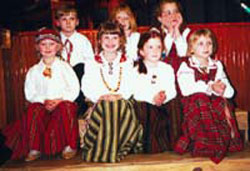
Melbourne Latvian Saturday School

Some of the youngest members of the Melbourne Latvian Saturday School “Daugava” pose for a photographer.

Daina Gross is editor of Latvians Online. An Australian-Latvian she is also a migration researcher at the University of Latvia, PhD from the University of Sussex, formerly a member of the board of the World Federation of Free Latvians, author and translator/ editor/ proofreader from Latvian into English of an eclectic mix of publications of different genres.